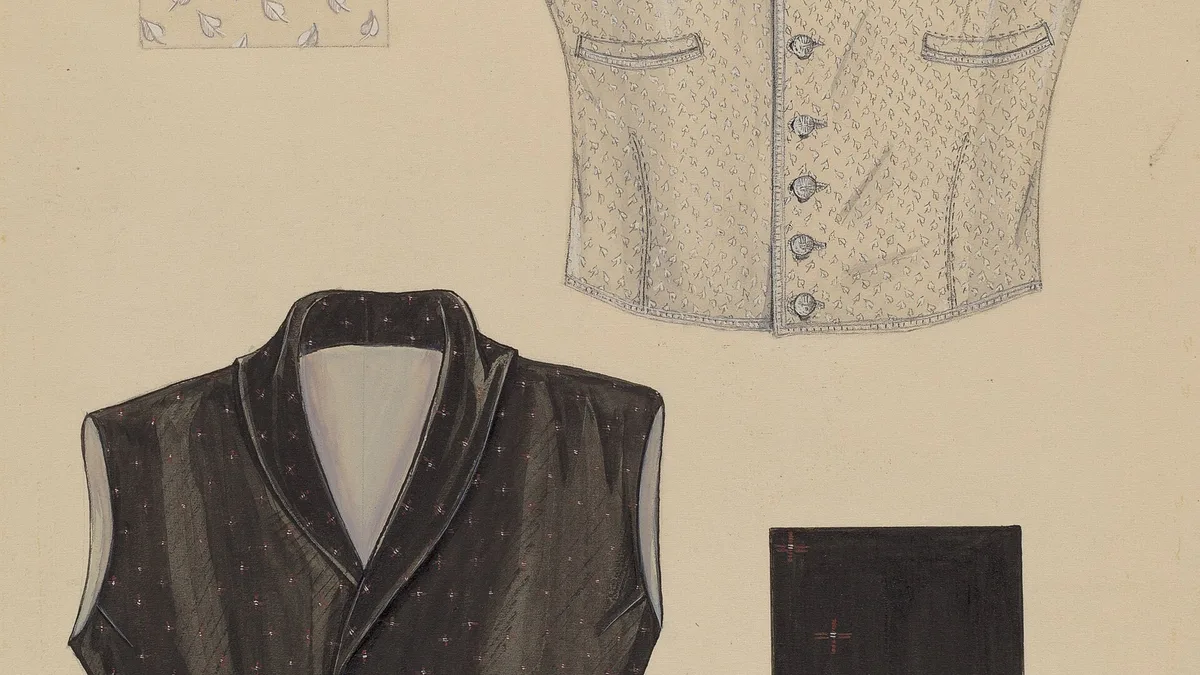
Waistcoats
| Country of origin | United Kingdom |
|---|---|
| First created | 17th century |
| Original use | As an undergarment for warmth and modesty |
| Garment type | Formal or semi-formal sleeveless upper-body garment |
| Occasion | Formal events, weddings, business attire, ceremonial dress |
| Heat context | Indoor or temperate outdoor settings |
| Closure | Front-buttoning, typically with a full or partial button row |
| Fit | Snug to the torso, tailored |
Origin and history
The waistcoat, known as a vest in American English, originated in England during the latter half of the 17th century. Its creation is widely documented as being popularized by King Charles II as part of a new, more restrained three-piece ensemble to replace extravagant doublets and jerkins. The initial design was a long, often sleeved garment that could be worn under a coat for both warmth and display of fine fabrics. Throughout the 18th century, it evolved into a sleeveless garment, becoming a standard component of formal male attire and a canvas for elaborate embroidery and patterns. The Victorian era saw the waistcoat solidify its role in business and formal dress, often cut from contrasting fabrics to the outer coat. By the mid-20th century, its everyday use declined, but it remained a cornerstone of formalwear, ceremonial dress, and certain traditional professions.
What it is for
The primary function of a waistcoat is to provide a polished, layered look within a tailored suit ensemble, adding formality and visual interest. It serves the practical purpose of covering the trouser waistband and the shirt's front, creating a seamless transition between the upper and lower halves of the outfit. In cooler environments, it offers an additional, close-fitting layer of insulation for the torso without the bulk of a full sweater or cardigan. The waistcoat also provides useful storage, as most are constructed with multiple pockets designed for discreetly carrying small items like pocket watches or tickets. For black-tie and white-tie events, specific waistcoat styles are mandatory components of the prescribed formal attire. Beyond strict formality, it can be used as a standalone garment in smart-casual contexts to elevate a shirt and trouser combination.
Waistcoats guide
Waistcoats are defined by several key structural elements, including the front closure, the cut of the front hem, and the presence of a back. The front closure typically features either a single-breasted row of buttons or, less commonly, a double-breasted arrangement with two parallel rows. The hem can be cut straight across or feature a pointed "V" shape at the bottom, known as a dip front, with the latter being more traditional for formal wear. A proper tailored waistcoat will have a back panel made from a secondary, often lining, fabric and will adjust via a buckle or strap system for a precise fit. Lapels can be absent (a "shawl" or "notch" style common with tuxedos), peaked, or notched, influencing the formality. Fabric choice is critical, ranging from luxurious silks and brocades for evening wear to sturdy wools, tweeds, or cotton for daywear and business suits.
Overview
A waistcoat is a sleeveless upper-body garment that buttons down the front, designed to be worn over a dress shirt and beneath a suit jacket or coat. It is a cornerstone of traditional menswear, signifying a considered and complete approach to tailored dressing. The garment covers the torso from the shoulders to the waist or just below, with the number of front buttons typically ranging from three to six. Its construction emphasizes a snug, tailored fit that follows the contours of the body without pulling or gaping. While historically ubiquitous, its modern use is largely confined to formal occasions, certain business environments, and as a stylistic choice in classic or vintage-inspired attire. Correctly worn, the bottom button of the waistcoat is traditionally left unfastened, a convention with practical historical roots.
What to know
The fit is paramount; a waistcoat must lie flat against the chest and stomach without any pulling of the fabric or visible shirt bunching, and it should be long enough to cover the trouser waistband completely. In hot weather, a waistcoat made from lightweight, breathable fabrics like tropical wool, linen, or cotton can be worn without a jacket, though this requires careful coordination. For high-formality events like weddings or black-tie functions, the waistcoat should match or complement the suit fabric and follow established dress codes, such as a cummerbund or low-cut waistcoat with a tuxedo. A common mistake is wearing a waistcoat that is too loose, which creates unsightly billowing and defeats its purpose of providing a sleek silhouette. The back of the waistcoat is not meant to be seen; it should be fully concealed by the suit jacket when worn as part of a full three-piece suit. Maintenance is specific, as structured waistcoats often require professional cleaning to preserve their shape and interfacing.
Common questions
Is it acceptable to wear a waistcoat without a jacket? Yes, in smart-casual or certain professional settings, provided the waistcoat is designed for this purpose and fits impeccably. What is the rule about the bottom button? The bottom button should traditionally remain undone, a practice dating to King Edward VII that accommodates movement and a comfortable fit. Can any suit be turned into a three-piece suit? Only if a matching waistcoat is commissioned from the same fabric batch, as dye lots can vary significantly, making an off-the-rack match difficult. How does a formal evening waistcoat differ? A formal waistcoat for black-tie is often low-cut to display more shirtfront, may be made of silk or barathea, and is frequently backless, attaching via side tabs. What is the purpose of the pocket on the right side? This is historically a watch pocket, designed to hold a pocket watch, though it is now used for other small items. Are waistcoats only for slim body types? No, but the fit is more challenging; a made-to-measure option is often necessary for a flattering fit on larger frames.
Pros and cons
A significant advantage is the enhanced formality and sophisticated silhouette it provides, completing a suit and adding a layer of visual texture through fabric contrast. It offers practical benefits like extra pockets and, in cooler settings, additional warmth without restricting arm movement like a sweater might. The primary con is discomfort in sustained heat, as the extra layer traps body warmth and can feel restrictive, especially if the fit is too tight. Many who regret wearing one find they have chosen a poor fit, either too tight, causing the fabric to pull, or too loose, creating a boxy, unkempt appearance. A common mistake is pairing a waistcoat with an ill-fitting shirt, where sleeve length or collar issues become glaringly obvious once the jacket is removed. Furthermore, an off-the-rack waistcoat rarely matches a separate suit perfectly, leading to a mismatched look that can appear costumey rather than sharp.
Who it suits
Waistcoats suit individuals participating in events with explicit formal dress codes, such as traditional weddings, galas, or diplomatic functions, where they are often expected. They are well-suited for those in certain classic professions, like barristers, head waiters, or sommeliers, where the garment forms part of a professional uniform. Individuals with a classic or vintage-inspired personal style who appreciate layered, tailored looks can successfully incorporate waistcoats into smart-casual wear. It particularly suits those who have invested in made-to-measure or bespoke tailoring, as the precise fit required is far easier to achieve through customization. People who frequently attend outdoor events in changeable cooler weather may find a waistcoat a practical and stylish insulating layer. Conversely, those in consistently hot and humid climates, or in ultra-casual work environments, will find limited practical use for the garment.