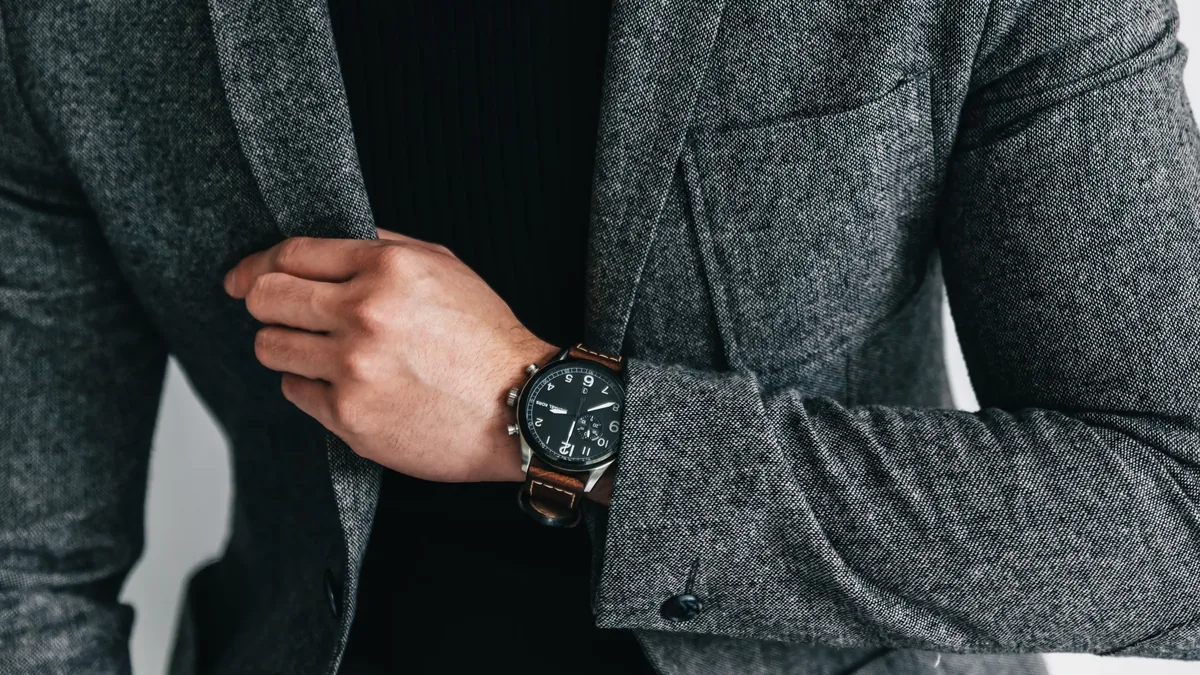
Blazer
| Country of origin | United Kingdom |
|---|---|
| First created | Early 19th century |
| Original use | Naval and sporting attire |
| Typical occasion | Business, formal, or smart-casual |
| Typical fabric | Worsted wool or wool blends |
| Formality | Ranges from formal to casual |
| Structure | Tailored with structured shoulders |
| Closure | Single- or double-breasted button front |
Origin and history
The blazer originates from England in the mid-19th century. Its creation is widely attributed to the rowing club of St. John's College, Cambridge, or to the crew of the HMS Blazer. The garment was first documented in the 1830s or 1850s, developed as a distinctive jacket for members of these groups. Initially, it was a navy blue jacket featuring polished brass buttons, often bearing a club or ship's insignia. This design served to create a uniform appearance that was less formal than a full dress coat. The blazer's name is popularly believed to derive directly from the HMS Blazer, whose captain mandated such jackets for his crew. Over the following decades, it transitioned from a sporting and club uniform to general casual wear for men and later women.
What it is for
A blazer is a tailored jacket designed to provide a structured, polished appearance in semi-formal and smart casual settings. Its primary function is to elevate an outfit without the formality of a matching suit jacket. It is worn in professional environments like offices with business casual dress codes, at social events such as weddings or garden parties, and in academic settings. The garment is intended to be versatile, allowing it to be paired with trousers of a different color or fabric, or with dresses and skirts. It serves as an adaptable layer that can add authority in a work context or a touch of refinement to casual separates. Unlike a suit jacket, it is specifically meant for mixed-and-matched ensembles, bridging the gap between formal tailoring and informal wear.
Pros and cons
A significant pro of the blazer is its versatility, as it can integrate into a wide range of outfits for different occasions. It provides structure and can improve the silhouette, offering a more polished look than a cardigan or unstructured jacket. However, a common con is discomfort in warm weather, as its traditional construction with canvas interlining and often non-breathable synthetic blends can trap heat. Many people regret choosing a poorly fitted blazer, which can appear boxy or constricting, particularly across the shoulders and back. The classic mistake is selecting a blazer that is too formal in fabric or cut for the intended casual setting, making the wearer look overdressed. Conversely, a blazer that is too casual, made from wrinkled linen or overly loose, can fail to provide the intended smartness for professional environments.
Who it suits
The blazer suits individuals who require a garment that transitions between professional and social settings with minimal effort. It is particularly effective for those with a body type that benefits from the structured shoulders and defined waist typical of a tailored cut, as it can create a flattering V-shape torso. People in creative or business casual industries often find it an essential component of their wardrobe, as it conveys competence without formality. It suits wearers in temperate climates best, as its weight can be impractical in sustained high heat or deep cold without specific fabric choices. The garment also suits those who prefer a classic, enduring style over fast fashion trends, given its stable design history. Ultimately, it is a practical choice for anyone needing a single layer to instantly smarten trousers, jeans, or a dress.